“The fruit of the Spirit is love, joy, peace, patience, kindness, goodness, faithfulness, gentleness and self-control.” Galatians 5:22
I strive to produce fruits of the Spirit. I desperately want to be loving, joyful, peaceful, patient, kind, good, faithful, gentle and self-controlled. I hope that if I clench and squeeze with all my might, I will push out those fruits.
After years of trying, I can say conclusively that clenching and squeezing hasn’t helped me materialize any peace or joy. For me the only crop this technique successfully produces is anxiety.
If clenching and squeezing and pushing and striving doesn’t produce love, joy, peace, patience, kindness, goodness, faithfulness, gentleness and self-control, then what does? How do I become spiritually fruit-bearing?
Zucchini has taught me something about this.
My mom in Michigan grows zucchinis the size of small dogs and in such abundance that she can feed the whole town.
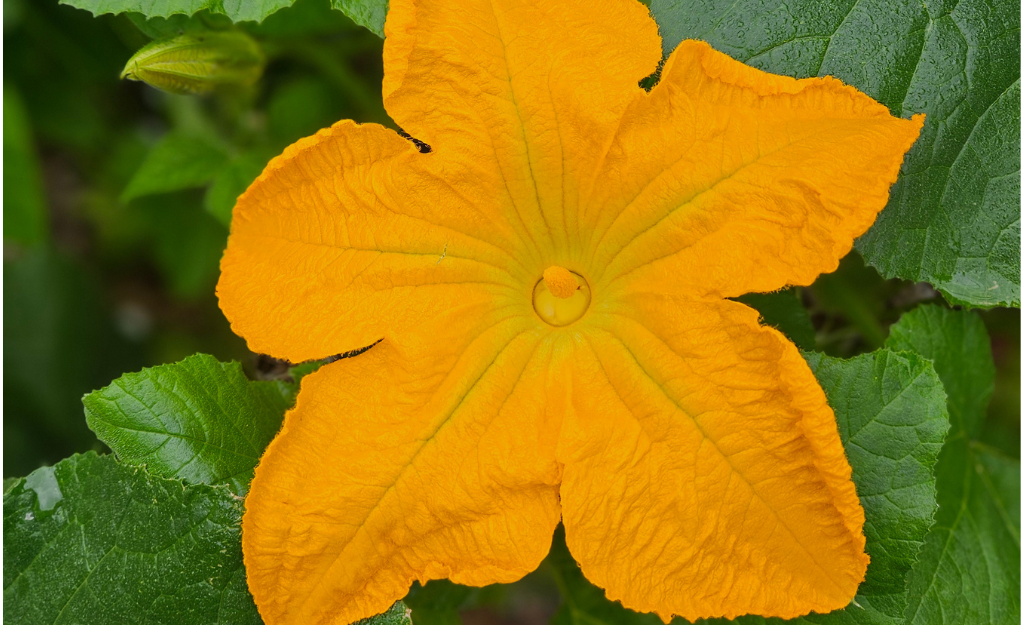
Last year I attempted to grow zucchini in my little backyard garden. In a few weeks, I had a thick vine with several enormous yellow blossoms. I spotted a single pre-zucchini starting to fatten under one of the umbrella leaves. Delight!
My delight turned to confusion when I noticed the zucchini was failing to thrive. Confusion became despair when I saw the base of the vine. It was a rotten and mangled mess. My zucchini plant had been attacked by vine borers – fat, white, grub-like jerks that eat the vine from the inside out.
Despite being barely attached to the main vine, the poor zucchini plant continued to struggle along, even pushing out a few weak leaves. It was alive, but it was not flourishing. Try as it might, it was not going to bear any fruit.
The vine is the source of life and vigor for the plant. All of the nutrients flow up through it into the branches and leaves and ultimately the fruit (or, in this case, vegetable). If I want a good harvest, I have to have healthy branches that are securely attached to the vine.
In the gospel of John, we read Jesus’ teaching about how to bear good fruit though our lives.
Jesus said, “I am the true vine, and my Father is the gardener. He cuts off every branch in me that bears no fruit, while every branch that does bear fruit he prunes so that it will be even more fruitful.” John 15:1-2
“Remain in me, as I also remain in you. No branch can bear fruit by itself; it must remain in the vine. Neither can you bear fruit unless you remain in me. I am the vine and you are the branches. The one who remains in Me, and I in him, will bear much fruit. Apart from Me you can do nothing.” John 15:4-5
If I believe Jesus’ words, then first of all there is nothing I can do to force out the fruit. The fruit comes naturally as a result of my healthy attachment to the vine.
Second, if my existence is not full of vigor, something is wrong with my connection to the vine. Jesus’ instruction to his disciples is to “remain in Him.” I have been thinking about what it looks like to remain in Him. The word remain is sometimes translated as abide, or to stay. As I see it, my responsibility is to use my God-given agency to protect my connection to God through Jesus, who is the source of life and vitality.
John 10:10 records these words of Jesus: “The thief comes only to steal and kill and destroy; I have come that they may have life, and have it to the full.”
It takes some investigative work to identify the vine borers that chronically or acutely damage the flow of the Spirit to me and through me. Once I’ve found them, I need to eradicate them.
If we go back to the zucchini plant, here are instructions for how rid one’s vine of the damaging borers:
Identify the damaged part of the vine. Use a sharp, clean knife and make a cut to expose the grub-like vine borer. Pull it out and kill it.
I’ll be honest, when I learned this is how to fix my zucchini problem, I was like, nah, I’m good. I am not that fond of zucchini. Eradicating the vine borer is painful and difficult, and requires fortitude and a strong stomach. You have to really want that zucchini.
Today as I write this, I have recognized damage in my connection to the vine. It shows up as times I’ve stayed quiet when I should speak up; or hung back when I should step forward; or listened to a lie that is louder than the quiet whisper of truth and love.
If I make the cut to see what’s eating the vine and behind these behaviors, I will find a gross white grub named fear. Specifically fear of inadequacy and of being a disappointment.
1 John 4:18 says, “There is no fear in love. But perfect love drives out fear.”
To eradicate my vine borer named fear, I need to first decide how much I want the ‘life to the full’ that Jesus described. I remember my choice to let my zucchini plant carry on with its festering wounds in its half-alive state. I could choose to do the same with this one life I’ve been gifted.
Or, I can grit my teeth and make the cut: speak up, step forward, make the decision. Then I can lean into faith that God’s perfect love is sufficient to cause life to flow into and through my healing connection to Him. Once the wound is cleaned and healed, good fruit will come in time.
An invitation to consider
Ask God for eyes to see and a heart to receive what He has for you today.
Read John 15
Jesus came so that we can have life – flourishing and fruitful. Identify something that is flourishing and fruitful. Spend some time in gratitude for the life-giving nature of God that makes such things possible.
Consider the state of your connection with your source of life and vitality; that is, God. Ask God to show you how he is restoring and regenerating His connection to you. Consider how you might care for your connection to Him.
May the Lord bless you and keep you. May He make his face shine upon you and be gracious to you. May the Lord turn his face toward you and give you peace.
See, I am doing a new thing! Now it springs up; do you not perceive it? I am making a way in the wilderness and streams in the wasteland. Isaiah 43:19
I love a good walk in the woods. In autumn especially, I find the ground covered in brown leaves that crunch quietly under my step. Once plump and vibrant on the branches, the leaves have detached and fallen.
The leaves have died.
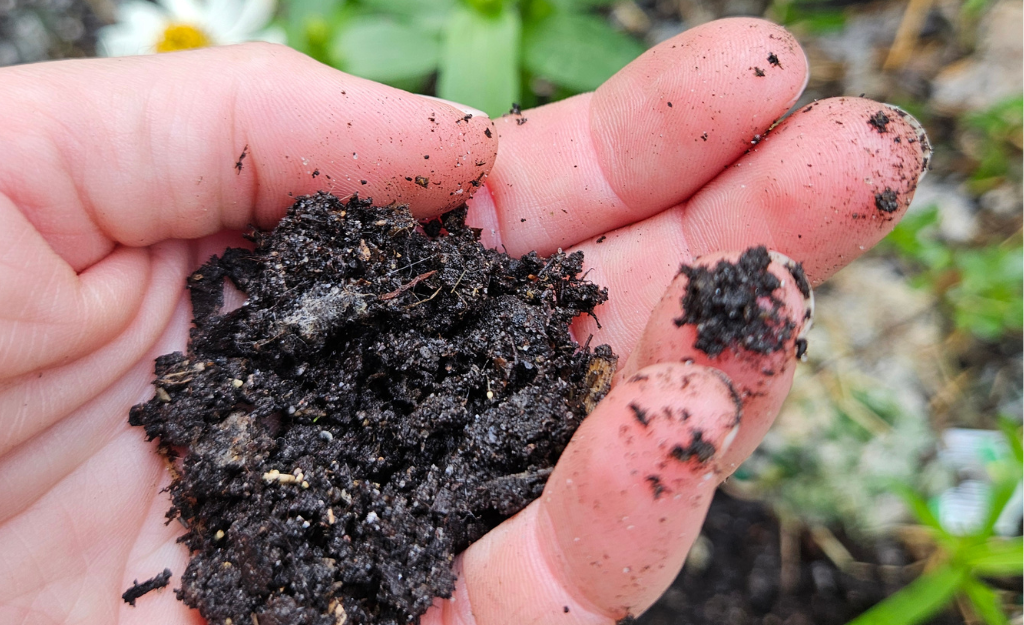
When I dig a little under the top blanket of leaves, I find older layers that have decomposed into a damp, crumbly humus.
They are very dead.
Outside of the woods, sometimes I look around at my world and it feels like everything is decaying. Especially if I watch the news too much. Death and destruction are everywhere. It’s a dumpster fire out there. Sometimes the dumpster fire is inside my home. Sometimes it’s inside my head. How can I respond? Despair or rage or panic – pick a card.
How does God guide me through this valley of the shadow of death?
Let me go back to the forest floor. Look! I can see thin, white threads of living mycelium (fungus fingers!). I spot a worm. Beyond what I can see, there are a billion microbes living their best lives in a teaspoon of that stuff. I notice green sprouts popping up out of the decomposing material. Seeds have scattered from a dead flower, and they are coming to life in the soil. The dead and decomposing material nourishes them so they can germinate and grow.
Death and re-birth are both fully present in the soil.
See, I am doing a new thing! Now it springs up; do you not perceive it? I am making a way in the wilderness and streams in the wasteland. (Isaiah 43:19 ) This is a verse from the the Old Testament prophet Isaiah. It was a message to a people who had turned away from God and disconnected from their life source. It was a time of decay. In the middle of that place of desolation, God called His people to wake up and look around. He is making something new come alive.
When it seems like restoration is impossible, God is bringing something beautiful to life.
For Christians, Jesus’ death and resurrection are the cornerstones of our faith. Jesus, whom Paul describes in Colossians as the image of the invisible God, was born, lived, and died. According to the Gospel accounts, Jesus came back to life again three days after his death. Christian theology holds that, by Jesus’ death and resurrection, the destructive power of sin and death are utterly destroyed. Now, God is using the decomposing material as the medium to redeem, restore, reconcile, and recreate.
“Therefore, if anyone is in Christ, he is a new creation. The old has passed away; behold, the new has come.” 2 Corinthians 5:17
“Jesus said, ‘I am the resurrection and the life. The one who believes in me will live, even though they die; and whoever lives by believing in me will never die. Do you believe this?’” John 11:25
In the compost on the forest floor, I can see a small glimpse of God’s grace and His perfect plan, which is completed in Jesus and is being carried out in us. Death is not the end. He is making something new.
A robust theology of the compost reminds us that death and the things of death, our sin, our suffering, the ways we hurt each other, the ways we harm ourselves— These things are never the end of God’s story.
A robust theology of the compost reminds us that we are still in the process of becoming, and God has written redemption into the story of creation itself.
A robust theology of the compost reminds us that God has empowered us, lowly worms, to turn what is ugly and festering and dying into what is lovely and beautiful and life-giving.
A robust theology of the compost testifies to the fact that we can’t do this alone, but we need others, because a single worm can’t do very much but in community they have such tremendous power.
A robust theology of the compost testifies that we who have been told by society that we are worthless can act in the confidence of the knowledge that we are worthy.
And a robust theology of the compost testifies that God urges those of us who have been shamed not to shame, but instead to love. Because in our acts of love, we participate in preparing the soil in which God’s reign of love and justice can take root.
For me, the story of compost shows that God is constantly bringing new life out of death. He does it with every falling leaf that becomes food for a new plant to grow, and with every plant or animal whose death enables me to nourish my body. He does it so regularly that I consider it mundane.
When I am in a season where it seems like death and despair have the upper hand, faith is believing that even then – especially then – God is bringing something beautiful to life. God is making dead things come alive all around me, and in me, all the time. Do I perceive it?
An invitation to consider
Ask God for eyes to see and a heart to receive what He has for you today.
If you are in a season of death and grief, may God hold you gently through the process.
In His good time, may He reveal to you new life that was emerging all the while.
May the Lord bless you and keep you. May He make his face shine upon you and be gracious to you. May the Lord turn his face toward you and give you peace.
“Then the Lord God formed a man from the dust of the ground and breathed into his nostrils the breath of life, and the man became a living being.” Genesis 2:7
My entry today is about something strangely close to my heart.
Dirt.
Soil, actually.
Dirt vs. Soil – What’s the Difference?
There is a difference between dirt and soil. The Soil Science Society of America defines dirt as “displaced soil.”
The stuff someone tracked in my house on the bottom of their shoe is called dirt. The dusty layer at the edge of a highway, which herbicides have stripped of all plant material, is called dirt. If it’s messy and inconvenient and we want to get rid of it, we call it dirt.
How is soil different? If you paid good money for it from a quality farm or garden center, or you spent months or years cultivating and fertilizing and PH-balancing it so that you can grow your prized tomatoes or hydrangeas, you will call it soil.
The difference is how you understand its value.
What is valuable?
Jesus had a different view of what is valuable than most of the people around him.
“Truly I tell you, this poor widow has put more into the treasury than all the others.” Mark 12:43
“Are not five sparrows sold for two pennies? And not one of them is forgotten before God.” Luke 12:6-7
“For it is the one who is least among you all who is the greatest.” Luke 9:48
“The King will reply, ‘Truly I tell you, whatever you did for one of the least of these brothers and sisters of mine, you did for me.’” Matthew 25:40
Remembering Where we came from
Around 3,500 years ago, the Jewish and Christian holy scriptures told our origin story like this: the Creator of the universe formed a person out of topsoil and breathed sacred life and spirit into it. God made it this way and pronounced it “Very Good.” Thus, humankind was made, according to the book of Genesis.
“Then the Lord God formed a man from the dust of the ground and breathed into his nostrils the breath of life, and the man became a living being.” Genesis 2:7
Practical observation and life science confirm the bible’s account that we are made from soil.
I am made of Soil
Let’s have a quick refresher on the nutrient cycle: The plant consumes nourishment from the soil, embodying the soil’s nutrients in its cell structures. The animal consumes and embodies nourishment from the plant. Now the animal also contains the nutrients from the soil. The human consumes the plant and the animal, embodying the elements that first came from the soil. With every meal I consume, I am very literally being made of the materials that came out of the soil. The very same materials that worms eat and discard is literally what makes up the cells of my body and blood.
“I am sacred. I am wild. I am earth and heaven’s child,” sings Charity Muse on her album Dirt Church Hymns.
So was Jesus
The books of Matthew and Luke both record Jesus’s last supper with his closest friends.
“Jesus said, when you eat the bread, remember ‘This is my body, which was broken for you.’” Luke 22:19
Jesus often spoke in mysteries. But in this case, there is also a very practical reality to his words. Jesus reminded his disciples that the person they worship as the Son of God is made up of the very same materials that compose their bread and wine. His disciples were to remember the body of God incarnate was given so that they could be nourished. The elements that nourish us are of Him and from Him, and they are sacred.
What Is treated like dirt?
I wonder what I have thought of as dirt, when God made it to be soil. Have I thought of myself as dirt, when God made me to be soil?
God is often germinating a seed in places where most of us only see an inconvenient mess. Where others see dirt, God might be inviting us to see something sacred – something He has created on purpose and for a purpose.
Do I have faith in the abundant and flourishing potential God breathed into each carefully crafted individual and the collective whole of His world? Is there a dry and infertile area in my life that needs to be fed and watered so it can produce an abundant crop as God intended?
Some of us might need to take a moment and ask God to open our hearts to receive the unfathomable love and care with which He created us and continues to nurture us day by day.
My prayer today is that God will give me the eyes to see the value of what God created; give me a heart that treasures God’s gifts; and give me the wisdom to to care for His treasures well.
An invitation to consider
Ask God for eyes to see and ears to hear what he wants to teach you today.
Read Matthew 13.
Go outside and find some soil. Hold it in your hand. Consider that this soil you’re holding is the building blocks of the food that nourishes and sustains your physical body.
Take a moment to allow yourself to see a gift given by God and feel gratitude for it.
Some of us might want to take a moment to ask God what we are treating like dirt, when God created it to be soil. If He has given you a new awareness, how would He like you to respond?
May the Lord bless you and keep you. May He make his face shine upon you and be gracious to you. May the Lord turn his face toward you and give you peace.
Jesus told them a parable: ‘The kingdom of heaven is like a mustard seed, which a man took and planted in his field. Though it is the smallest of all seeds, yet when it grows, it is the largest of garden plants and becomes a tree, so that the birds come and perch in its branches.’ Matthew 13:31-32
Tiny Seed
The first plant from which I intentionally harvested seeds was broccoli. I was flabbergasted by broccoli seeds. Yes, I said flabbergasted.
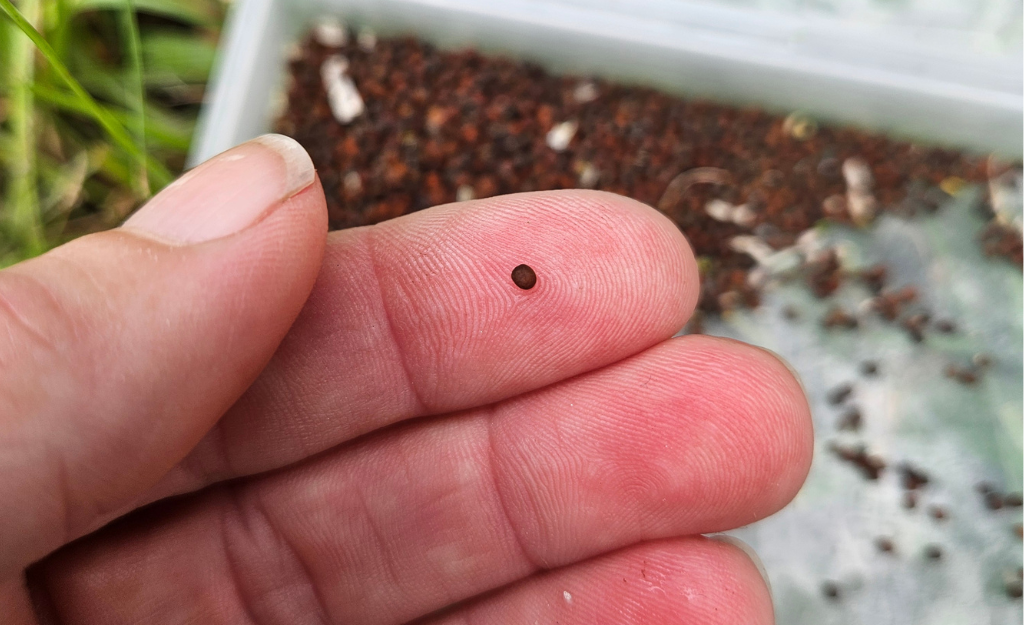
The broccoli seed is itty, bitty, teeny, tiny. It is so small it’s difficult for me to pick up and hold it between my huge fingers.
Huge Potential
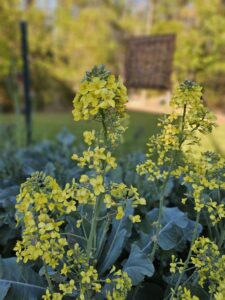
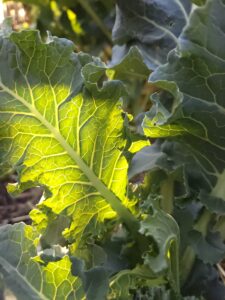
Its tiny-ness is contrasted by the plant that produces it. At the seed-bearing stage, broccoli plants are gargantuan. They grow taller than me by far, and have enormous waxy leaves that are themselves longer than my arm and wider than my body.
The plant produces a broccoli head, the part many of us like to eat with ranch dressing or roasted with a little salt and olive oil. When you look closely at a broccoli head, you see it is made up of teeny, tiny green buds.
If you were to leave that broccoli head attached to the plant, you’ll discover that each of those tight, little green buds grows into a yellow flower. When the flowers are spent, they leave behind scores of long, thin beans, each containing a dozen or so seeds. A single broccoli plant can produce thousands of seeds.
Abundance
There is so much abundance. It is over-the-top. It is extravagant.
Just one of these tiny seeds has the potential to produce a plant that will outgrow me, and which can provide me with food this season and the capacity to produce hundreds more plants for food.
Whilst the broccoli plant is doing all that amazing work, it is also providing other services like creating habitat for frogs among its waxy leaves, feeding pollinators with its abundant flowers, loosening the soil with its root structure.
That first year, I collected maybe 40 or so dried pods from the plant. I couldn’t possibly collect them all. Dozens were left for the birds. I cracked open the pods and chased the tiny seeds into a container. Seeds were rolling everywhere. I couldn’t possibly catch them all. I collected more seeds than I could count, more seeds than I could possibly plant in my garden space.
I said to myself, “I could give some of these seeds away and still have plenty!”
I put the message out to my friends and neighbors – who wants seeds?!
A Very Good System, Designed for Sharing
I realized with awe and wonder – this is God’s economy. This is the very good way He designed His creation to work. He made the seed. He caused it to grow. He blessed it and made it exceedingly abundant. It is enough for me, for the bees, for the birds, and for many others.
We’re Invited to the Party
In Matthew, Jesus is recorded as telling his disciples “the Kingdom of Heaven is like a mustard seed (side note – mustard seeds are about half the size of a broccoli seed) which a man took and planted in his field. Though it is the smallest of all seeds, yet when it grows, it is the largest of garden plants and becomes a tree, so that the birds come and perch in its branches.” Matthew 13:31-32
Jesus’ story isn’t just about the mustard seed and the amazing thing it grows to become. He includes people as participants in the wonder-work. “The Kingdom of Heaven is like a mustard seed which a man took and planted in his field.”
There are a few steps the person is invited to take in this story about the Kingdom of Heaven.
First, the man needs to take the seed from the one who offers it.
Then he needs to carry it to his field.
Then he needs to place it in the soil.
An Unplanted Seed Doesn’t Grow
My friend Jeremy gave a message about stewardship that has stuck with me for years. He reminded us that seeds need to be planted in order to produce a crop. If I’m being honest, I like to keep the seed in my pocket. I like to know it is safely tucked away so that I will have it when I need it. But a seed in my pocket will never grow. I have to drop it into the soil and trust that God will cause it to produce as it was intended.
I need Jesus to keep reminding me “Very truly I tell you, unless a kernel of wheat falls to the ground and dies, it remains only a single seed. But if it dies, it produces many seeds.” John 12:24.
Overcoming Scarcity Fears
Here, I need to make a confession. As I was divvying seeds into smaller packages, a voice in my head started fretting. What if my plants don’t take? Maybe I should save some extra seeds, just in case. And maybe I should set aside a few more for the year after, just in case something goes wrong with the harvest.
Building resilience is important, and there are times to save for the future. At the same time, I am reminded of a talk Joshua Becker (author of Uncluttered Faith) gave recently here in Savannah. He shared that, when he published his book, he and his family decided they had enough financial resources for their needs so they chose to use income from the book to start a non-profit for orphan care. He encouraged listeners to consider whether we might be holding onto resources in case of “what if” scenarios that may not ever materialize, when God has a purpose for those resources to be used for “what is,” now.
If I were to try to keep all of those broccoli seeds, they might stay in my refrigerator for years, never producing any broccoli and eventually becoming nonviable. If I give them away, they multiply in the world.
God has shown me that He can produce a broccoli plant from a seed smaller than a pinhead, and that He is faithful to do it season after season. Will I trust Him and plant the seed he has given me for today? Will I trust Him to continue to provide in the future?
AN invitation to consider
What am I holding in my pocket that God has invited me to use up or give away?
What fear is holding me back from taking His invitation?
God, give me the courage to plant the seed I am holding!
May the Lord bless you and keep you. May He make his face shine upon you and be gracious to you. May the Lord turn his face toward you and give you peace.
How to protect a garden from aphid infestation, a devotional
The Lord God took the man and put him in the Garden of Eden to cultivate it and protect it. Genesis 2: 15
Aphids: a gardener’s challenge
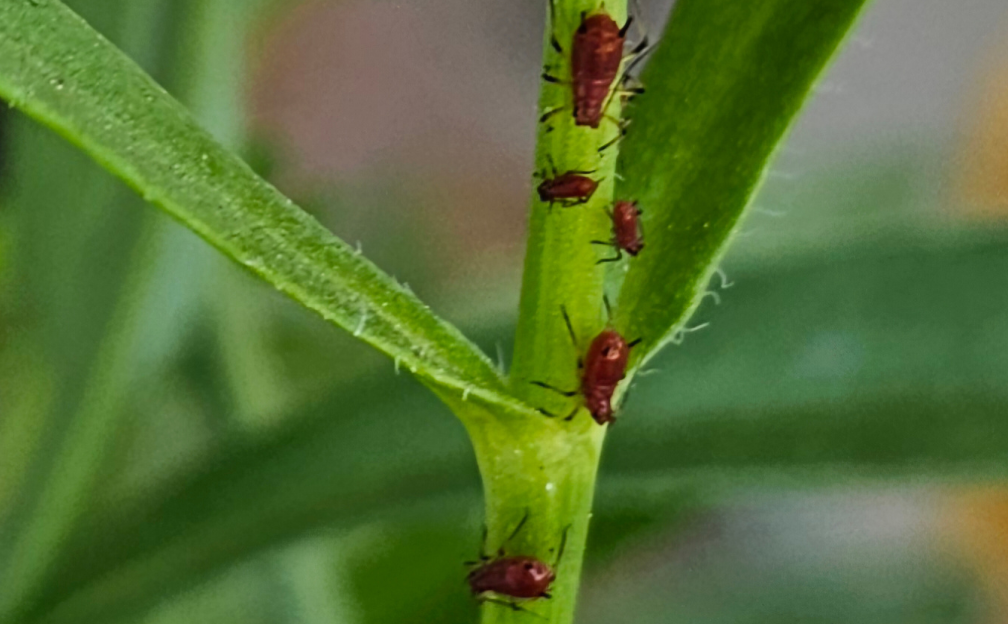
Aphids are sap-suckers. When an aphid colony settles on a host plant, the tiny insects pierce the tender stems and leaves of plants and suck out energy-rich liquid from the plant’s veins.
Sap-suckers can weaken their host plant
Aphids can do a lot of damage to a garden in a short amount of time. They have a unique reproductive capability whereby, under certain environmental conditions, they give birth to a bunch of clones of themselves (eek!) that are each already pregnant (eek again!) with up to 100 additional offspring (EEEEEKKK!). If aphids find a vulnerable plant in an unprotected ecosystem, an aphid colony will explode in population within a matter of days.
When aphids settle on a host plant in an area where there are not enough natural predators, they can quickly exhaust their host to the point that it can no longer sustain the colony. Then, the aphid colony will leave the damaged plant and move on to a new host. I find myself drawing parallels to times when I myself and my own species have exhibited aphid-like behaviors. And perhaps it will be insightful to consider both the aphid and the human as we continue.
What is a gardener to do in the event of an aphid uprising?
Indiscriminate Destruction is not the answer
For some, the first instinct might be to go on the offense. Bring out the pesticides! As it turns out, insecticides tend to be ineffective on aphids, since these particular creatures quickly build up a tolerance. Not only that, but insecticides can create devastating collateral damage by killing beneficial insects like pollinators.
Letting aphids run rampant is also not the answer
Personally, offensive action is not my go-to strategy. But my default can produce equally undesirable results. I tend to lean toward a hands-off approach. At one point in time, my response to an aphid infestation was to shrug and say to myself, “aphids will be aphids.“ And maybe even, “Gosh, that’s terrible for that poor plant. I’m so glad I’m not like those greedy, undisciplined aphids.”
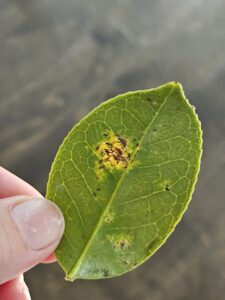
aphids on a camellia leaf
protecting the garden
The question of what to do about aphids has me thinking carefully about when it’s necessary to protect against harm and knowing how to do it wisely.
It’s fairly straightforward for me to understand that I should make every effort to avoid acting in harmful ways to those around me. It’s not always easy, but it is straightforward. I understand that I am responsible for my own behavior. I am obligated to consider my actions and determine whether they are harmful. When they are, I ought to change my behavior. Again, I don’t always do this, but I understand that I should.
But what about when someone is being harmed by someone else. What is my responsibility in such cases? Certainly there is a lot of nuance and each situation is unique.
I generally take a “live and let live” approach. I lean into the conviction that we should be careful not to judge others, that we should be merciful as God is merciful, and that God Himself will convict where necessary. While I believe all of this is true, the aphid teaches me not to be a bystander in cases where harm is being done to the unprotected.
In the case of an aphid infestation, I as the steward of my garden, have an opportunity and responsibility to take action to rescue the plant from attack, reduce suffering for the garden as a whole, and even prevent detriment to the aphid colony itself, which literally eats itself out of house and home.
Aphids, it turns out, do not typically awaken to the error of their ways and begin practicing moderation and self-control through the prompting of their own collective conscience.
For the health of the garden, God designed boundaries for aphids and people. Sometimes, the ecosystem enforces the boundary. It is possible, even probable, that sometimes I may be called upon to enforce a healthy boundary.
rebalance
After an aphid population explosion, the garden ecosystem is out of balance and generally can’t right itself without help. A gardener can and should intervene by manually removing infested parts of plants and destroying them.
But experienced gardeners will tell you the best way to prevent aphids from destroying a garden is a slow and inconvenient solution that must be maintained over seasons and years. The most effective protection against infestation is this: to encourage the health of the garden as a whole and within each of its parts (even the aphid).
Why? Because a thriving garden can withstand stress. A healthy garden can support a reasonable population of aphids, while keeping them from breaching the boundaries of balance. Keeping a garden healthy starts with good soil that produces well-fed, nutrient-rich plants. This creates an environment that welcomes a diverse population of insects, including predators like ladybugs and lacewings who feed on aphids. When the plant and animal population is diverse and healthy, every species has enough to eat and a place to live.
cultivate and protect
I trust God can use anything to draw us close to His love and show us how He is working in and around us, if we have eyes to see it. Here’s what God is showing me through aphids.
I am reminded of Genesis 2:15, where the ancients explained the Divine design for the relationship between God and people and the world:
The Lord God took the man and put him in the Garden of Eden to cultivate it and protect it. Genesis 2: 15
responsibility And stewardship
In the beginning, the Creator designed the world such that everything He created was in a pleasing relationship with Him and with each other. In this context, people were gifted with an important privilege and responsibility to the world around them – to reflect the image of God by both cultivating and protecting all He created.
Today, I am thinking about what the bible shows us about our responsibility to protect.
The Hebrew words used in Genesis for “cultivate” and “protect” are “abad” and “shamar”. This word pairing is the same one used in Leviticus to describe the duties of the Levites with respect to caring for the temple, the dwelling of God. Shamar means “to guard”, or “to watch over protectively.”
Let me pause there for a moment.
For evangelicals reading this post, let me point out that the words “abad” and “shamar” – or to “cultivate” and “protect” – were used before “the fall” (the theological concept of the point at which sin entered the world, resulting in suffering and separation from God). God didn’t observe the world falling apart and then devise a mitigation plan for good guys to start protecting their tribes from the bad guys that had suddenly appeared.
From the very beginning, before anything went awry, the Creator’s good and perfect design was for people to participate with God in building something beautiful together and protecting it against imbalances that might prevent it from thriving. In the beginning, God gave all humankind the responsibility and privilege to partner with Him in caring for and protecting the world He created and everything in it.
God calls us to protect, not to take vengeance
In the case of aphids or any person or thing that has caused harm, we are not called to take vengeance. The person or thing itself is part of God’s good design for the world. After all, God created them. John says, “Through Christ all things were made.” (John 1: 3) and Paul agrees in Col 1:16. Paul and John don’t exclude the aphid nor the cyberbully from “all things” and neither should we.
Instead, we are called to protect the wellbeing of what God created.
Whereas aphids – given unrestrained access – are destructive to the ecosystems upon which many species depend (including aphids themselves), the Creator has caused natural forces to restrain them. Take, for example, the many predatory insects He created to eat aphids like the assassin bug and the lacewing.
God has also given humans the ability to intervene, and the responsibility of doing it with care and discernment so that the impact is in line with His good and pleasing will. “And we know that God causes everything to work together for the good of those who love God and are called according to his purpose for them.” Romans 8:28.
By helping to rebalance when appropriate and then supporting healthy conditions, we contribute to an environment where all members of the community have an opportunity to live a healthy, balanced life and contribute to the wellbeing of the whole.
My response to this insight from the aphid is to continually ask God for wisdom to discern who and what He has charged me to protect, and how to act on that responsibility in alignment with His will. I must also continually search myself, asking God how He is calling me to protect from destructive tendencies within myself.
when it is my job?
In some cases it might seem obvious who I am charged with caring for and protecting. For example, most everyone would agree that I have a responsibility to care for and protect my children and my household. But, my neighbors might object if I jump over their fence and attempt to prune their rose bush without an invitation. Let’s consider another scenario: if I witness a neighbor’s child being harmed on the other side of the fence, now it is my responsibility to intervene regardless of who owns the title of the property where the harm is occurring.
It can be messy and complicated to determine what I am called to protect and even messier to determine how. Discernment and wisdom is needed. And frankly, I’ll probably get it wrong, a lot. But we can know He has told us in the scriptures that his will is for us to protect the vulnerable.
“Religion that God our Father accepts as pure and faultless is this: to look after orphans and widows in their distress.” – James 1:27
“Defend the weak and the fatherless; uphold the cause of the poor and the oppressed.” – Psalm 82:3
“Speak up for those who cannot speak for themselves, for the rights of all who are destitute. Speak up and judge fairly; defend the rights of the poor and needy.” – Proverbs 31:8-9
“This is what the Lord says: ‘Do what is just and right. Rescue from the hand of the oppressor the one who has been robbed.” Jeremiah 22:3
God’s whole creation was designed with care and protection built-in at every turn. We are all responsible to care for and protect each other. Sometimes my personal responsibility is to act directly. Sometimes it’s to empower another member of the body to take action. Sometimes I am not even aware of how we are all interconnected to create a resilient whole. God sees all the parts and causes them to work together for the good of those who love him and are called according to his purpose.
My prayer today: Lord, thank you for inviting me to help you care for what you have created. Let me be willing to serve in whatever capacity brings you glory. Give me eyes to see the beauty of what you created and faith in your provision to protect and sustain it through any storms or pestilence that may come. Show me when you intend for me to be the instrument of your provision and protection. Direct me toward what you have charged me to cultivate or protect, equip me for the job, and give me the wisdom and courage to obey your call.
An Invitation to consider
Take a moment to be still with the Creator of heaven and earth. Ask God to give you eyes to see and ears to hear what He would like to show you today.
Consider with gratitude and awe the balance of all of life that hangs moment by moment on God’s good and pleasing design, his mercy, his protection, and his love for everything He has created.
Ask the Creator of the universe how He would like to expand your awareness and capacity to love what He has placed under your care and stewardship.
Ask the Spirit to show you if there is a step He is calling you to take to care for or protect something He created and loves.
Be brave to step toward what God has called you to. Ask God to give you the strength for the job He has assigned. He certainly will.
May the Lord bless you and keep you. May He make his face shine upon you and be gracious to you. May the Lord turn his face toward you and give you peace.
 There is so much abundance. It is over-the-top. It is extravagant.
  I realized with awe and wonder – this is God’s economy. This is the very good way He designed His creation to work. He made the seed. He caused it to grow. He blessed it and made it exceedingly abundant. It is enough for me, for the bees, for the birds, and for many others.