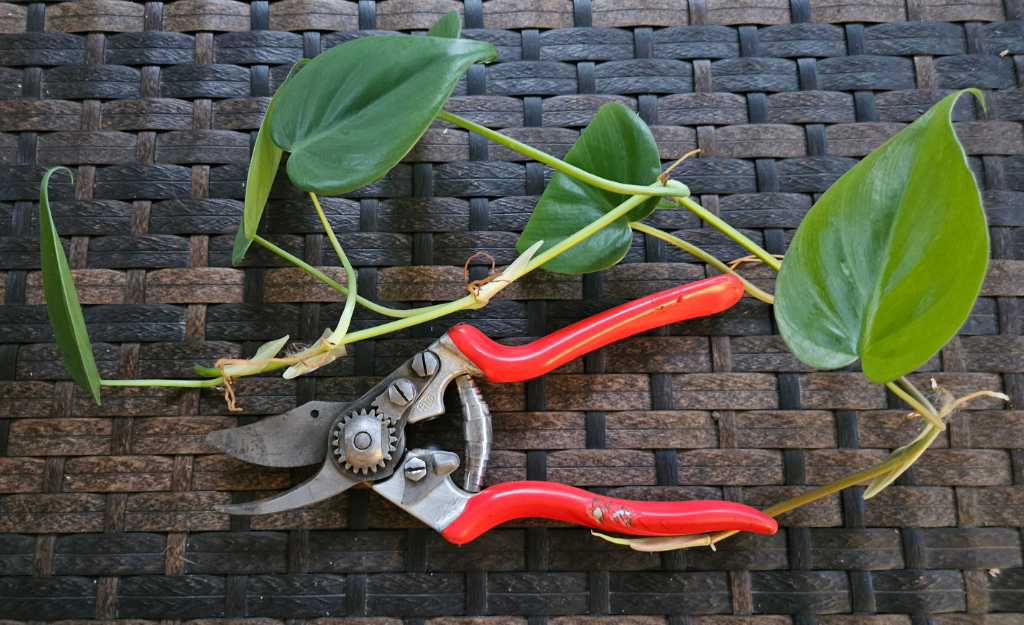
Pruning from the Plant’s perspective
“Jesus said, ‘I am the true vine, and my Father is the gardener. He cuts off every branch in me that bears no fruit, while every branch that does bear fruit he prunes so that it will be even more fruitful.’” John 15:1-2
My backyard garden is in its fourth year, and I have pruned back a number of trees and plants at this point. It’s still hard for me to do. The idea of cutting back my precious botanical babies is dreadful. I’ve invested a lot – physically, emotionally, financially, chronologically – into helping these little darlings grow up from a seed to a seedling to a full fledged plant. Now I need to cut back that hard-earned growth? It’s a lot to ask.
Yet, experienced gardeners understand that a disciplined approach to pruning is beneficial. Pruning discourages the plant from growing in inappropriate ways, while it encourages healthy, fruitful growth.
Before we go further, let’s define pruning. Pruning is the process of intentionally removing a part of a living plant.
Jesus used a pruning metaphor to help us understand how God shapes the growth of the living things he cares for. In John 15:1-2, He described his Father as the gardener who does the pruning; himself as the source of life who submits to being pruned; and his disciples as the branches to whom the pruning cuts are applied. If I believe Jesus, I should expect to be pruned – no question. If there is a question to be asked, perhaps it is whether I can receive the pruning in faith that the result will ultimately be more vibrance and fruitfulness.
Why is pruning necessary? Because life is not free. The process of living takes energy, and the individual has a limited amount of it available. When a skilled gardener removes part of a plant, she or he is concentrating that energy toward its most beneficial use.
One reason we prune a plant is to remove disease or damage. If diseased parts are left on the plant, they draw energy away from healthy growth, stunting the fruitfulness of the plant as a whole.
Pruning to remove disease makes sense. Even so, in my own garden I have struggled to make the necessary cuts to plants I care for. Last year, I had a cucumber plant whose leaves became afflicted with mildew. I was afraid that cutting off the part that was making the plant sick would kill it. I hoped it might recover if I just let it be. Any experienced gardener will tell you, this is a false hope. The mildew will spread, and the entire plant will succumb to it. Sadly, that was in fact the fate of my beloved cucumber, may she rest in peace. The takeaway – the disease must be removed, and the sooner the better.
The gospel of Matthew records a challenging message from Jesus to his disciples related to pruning: “If your hand or your foot causes you to sin, cut it off and throw it away. It is better for you to enter life crippled or lame than to have two hands and two feet and be thrown into the eternal fire. And if your eye causes you to sin, gouge it out and throw it away. It is better for you to enter life with one eye than to have two eyes and be thrown into the fire of hell.” Matthew 18, 8-9.
What I hear from Jesus’ teaching is that it will be both excruciating and inconvenient to remove what is sucking energy away from the life God has designed for us. At the same time, Jesus also said that he came so that we might have life and have it to the full. If I believe this, then I would be wise to welcome pruning in faith that it will result in a better and more flourishing life, even if the process is painful before it is beautiful.
I notice that Jesus tells his disciples to do their own pruning: if it’s pulling you away from God, “[you] cut it off, [you] gouge it out.” How often do I coddle the diseased parts of myself (investing even more energy) instead of removing them and channeling my limited energy into the life God designed?
It seems that it is God’s desire for us to use our own discernment and agency to prune off what hinders us. I feel it needs to be said that with pruning, precision matters. Master gardeners take the time to know exactly what they are cutting, where to make the cut, and why. In some of my early pruning efforts, I would fire up a hedge trimmer and indiscriminately raze down a section of an overgrown shrub. This is not a skillful technique. The process should be done deliberately and carefully.
John 15 seems to suggest that in cases where we can’t or won’t do the pruning ourselves, God will. Whether that is a comforting or distressing thought depends on whether I trust the divine Gardener more than I love being comfortable.
For me lately, the pruning seems to be targeted at my ego. The ways that I try to reach toward things that make me feel important, admired, useful, and validated are being trimmed. It’s been painful. Very. But, I am starting to see new growth. I notice a slow but perceptible shift in my attention and energy away from fearfulness and the striving for approval that has kept me stunted. I notice a slow but perceptible shift toward openness, curiosity, and acceptance of myself and others.
The scripture tells me it’s not just the diseased parts that are to be cut off, though. John 15:2 says “every branch that does bear fruit he prunes so that it will be even more fruitful.” For many fruiting and flowering plants, skilled gardeners prune back perfectly healthy parts of the plant. It seems counter-intuitive, but cutting back healthy plants focuses energy into producing better fruit or more abundant blooms.
As I write this, I’ve just finished re-reading the book of Job. Job is a quintessential poem that grapples with how it can be that a good God allows his loved ones to suffer. In the poem, Job, a good man, is living a blessed existence with material wealth, a happy family, and an honored position in his community. Suddenly he loses all his material possessions, his children are killed, and his body is subjected to agonizing sores. In the poem, God gives explicit consent to all this, meanwhile Job’s friends respond by unjustly attacking his integrity, nearly the last thing he has left. Oof.
HortGuide shares this advice about pruning grape vines: “You are going to remove roughly 90 percent of last year’s growth. That is not a typo, and it is not aggressive. An unpruned grape vine will produce dozens of small, flavorless clusters on weak wood while shading out the buds that would have given you fewer, better grapes next season. Pruning is how you direct the vine’s energy to the wood that actually fruits.”
At the end of the book of Job, God speaks directly to Job for the first time. Overcome with awe at hearing the words of the Creator, Job finally lets go of the remaining shreds of his ego. After this final pruning cut, we read that Job’s life bursts into bloom anew, more abundant than before.
Let me be utterly convinced that the Gardener is trustworthy. Let me be ready to accept the removal of anything that draws energy away from His good design. Let me hold every good thing in my life gently, not clutching and gasping, but with gratitude and an open hand. Let me cling firmly to faith that if God removes it, something better will grow.
An invitation to consider
- Ask God for eyes to see and a heart to receive what He has for you today.
-
Be still, breathe slowly, and consider that each breath is a gift from God. Take a moment to feel gratitude for the gift of life.
-
What is receiving your energy today? Is it fruitful?
- Think back to a time in the not distant past, maybe a year or three years ago. What was receiving your energy then? Was it more or less fruitful than today?
-
Is God prompting you to respond or take action in some way?
May the Lord bless you and keep you. May He make his face shine upon you and be gracious to you. May the Lord turn his face toward you and give you peace.